ARC Complete Restoration provides certified mold inspection and testing across King County, WA, and we are available around the clock for both emergency assessments and scheduled appointments. We do more than identify the problem. If mold is present, we handle remediation too, so you never need to find a second contractor.
If you smell something musty, see discoloration on your walls, or recently dealt with water in your home, you may already have a mold problem.
30 min response
We handle insurance
No upfront payment (if applies)
Seattle and the surrounding King County communities experience over 150 rainy days per year. That sustained moisture creates constant pressure on building envelopes, crawl spaces, and HVAC systems throughout every season. The Pacific Northwest’s mild temperatures and persistently high humidity provide near-ideal conditions for fungal growth, particularly during the fall and winter months when buildings stay damp for weeks at a time.
The region’s housing stock adds another layer of risk. Craftsman bungalows in Bellevue and Renton, mid-century split-levels in Kent and Federal Way, and older condominium buildings in Capitol Hill and South Lake Union all carry moisture vulnerabilities specific to their construction era. Dirt crawl spaces under older homes in Kirkland, Issaquah, and Auburn are especially prone to ground moisture accumulation when vapor barriers are absent or deteriorated.
One risk factor that rarely gets mentioned is the baseboard electric heating systems common throughout the Seattle area. These heaters create stagnant cold pockets along exterior walls, particularly behind furniture, where warm interior air meets a cold surface and condenses. That condensation feeds mold growth in areas that stay invisible until the damage is significant.
Approximately 47% of U.S. residential properties show visible mold or detectable mold odors, and damp climates like King County’s push that figure higher.
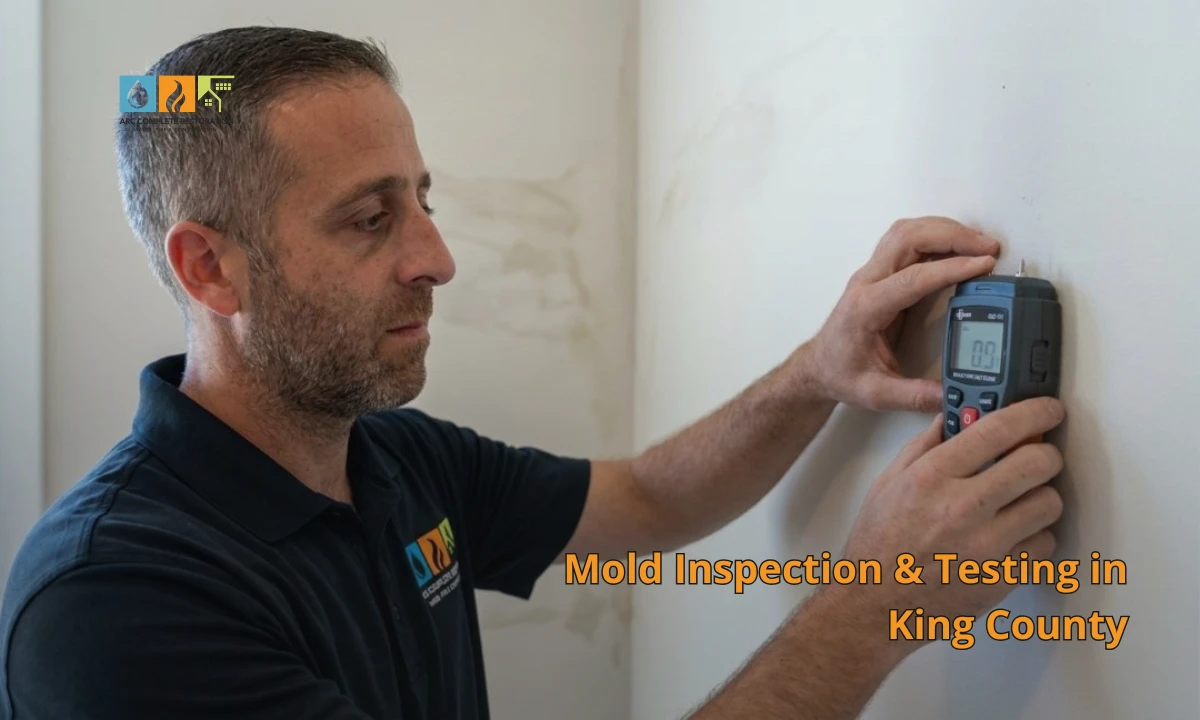
A professional inspection follows a structured sequence. Every step produces documentation that supports insurance claims, real estate transactions, or legal proceedings.
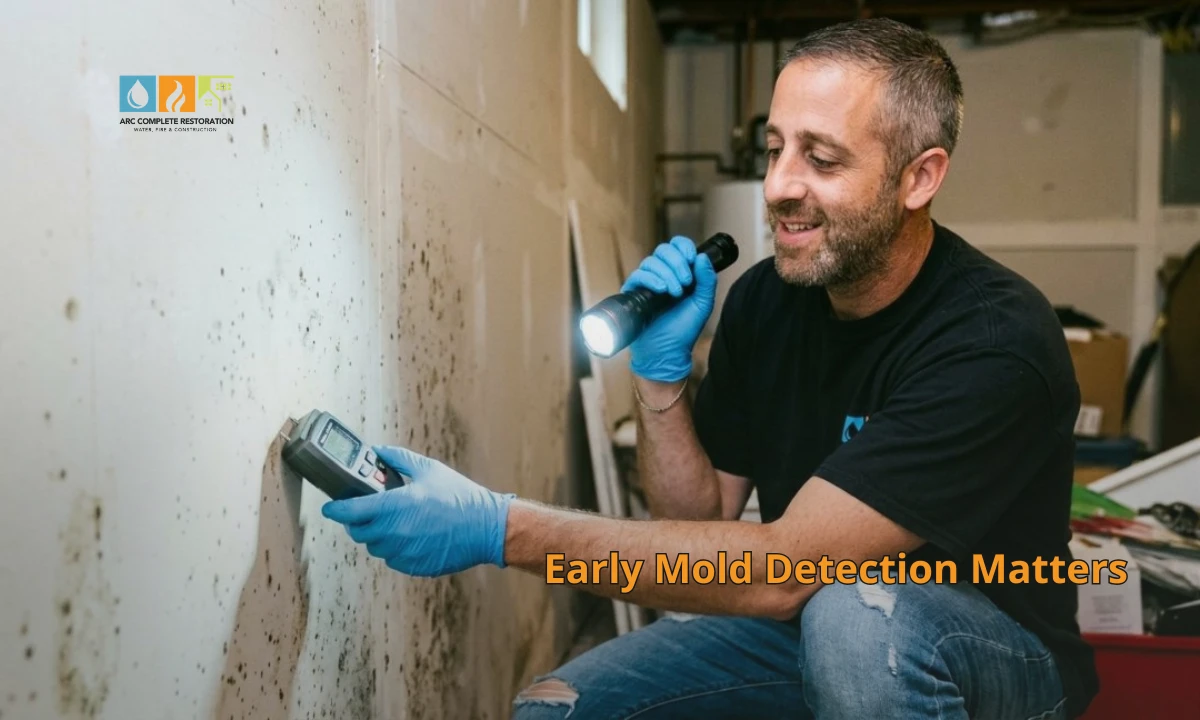
A certified technician examines all accessible areas including the attic, crawl space, basement, bathrooms, kitchen, and HVAC components. Calibrated moisture meters and infrared thermal imaging cameras locate moisture intrusion that the eye cannot detect.
Specialized equipment draws air samples from multiple locations throughout the property. A control sample is taken outside the building to establish a baseline. All samples go to an accredited laboratory for spore identification and concentration analysis.
Swab and tape lift samples collect potential mycotoxin deposits directly from suspect surfaces. This confirms species identity and informs the appropriate removal protocol.
When water intrusion has occurred behind drywall, cavity sampling identifies hidden growth without requiring full demolition. This step is particularly relevant for properties in Rainier Beach, Beacon Hill, and older Renton neighborhoods where plumbing failures go undetected inside walls for extended periods.
Results include species identification, spore concentration levels by room, a moisture map of the property, and written recommendations. A standard inspection with basic air and surface sampling takes an average of two hours. Properties with crawl spaces, complex HVAC systems, or suspected hidden growth take up to six hours.
This is where ARC differs from inspection-only firms. When the lab report confirms active growth, we transition directly to remediation without requiring you to locate a separate contractor. The written lab report is objective and transparent regardless of what follows.
If remediation is needed, we follow IICRC S520 protocols. Post-remediation clearance testing confirms the property is clean before we close the job.
Check our remediation services
Visible mold is obvious: dark or fuzzy spots on walls, ceilings, grout lines, or under sink cabinets. But mold often grows in locations you cannot see. Behind drywall, under flooring, inside wall cavities, and in crawl spaces are common hidden growth sites. If you notice a persistent musty or earthy odor without a visible source, that smell is frequently the first sign of concealed growth.
Health symptoms are another trigger. Respiratory issues, chronic headaches, allergic reactions, or fatigue that improve when you leave the building all suggest elevated indoor spore levels. Mold exposure has been linked to over 4.6 million asthma cases in the U.S., and over 21% of asthma cases connect to damp indoor conditions.
Mold can begin forming within 24 to 48 hours of water exposure. After a flood, burst pipe, or appliance leak, a professional mold inspection confirms whether growth has already started before it spreads further. If your property recently experienced water intrusion, our water damage restoration service and mold inspection work together as a single, coordinated response.
Washington State requires sellers to disclose known mold issues and water intrusion history. Unaddressed mold can reduce a home’s value by 20% to 37%. A pre-sale inspection protects buyers from inheriting a hidden problem and gives sellers documented proof of a clean property.
If household members experience persistent allergy-like symptoms, especially symptoms that ease when spending time outside the home, air quality testing measures indoor spore concentrations and identifies the species present.
Mold growing inside wall cavities, under flooring, or in crawl spaces often produces a strong odor long before it becomes visible. Air sampling and in-wall cavity testing locate the source without requiring demolition.
Laboratory analysis identifies the specific species present, which determines how aggressive the remediation protocol needs to be. The most common types found in King County homes are Stachybotrys chartarum, Aspergillus, Cladosporium, and Penicillium.
Stachybotrys chartarum, commonly called black mold, appears dark green or black with a slimy texture. It grows on materials with high cellulose content: drywall, carpet padding, insulation, and subflooring.
It requires constant moisture to survive, which makes it common in King County basements, chronically damp bathrooms, and areas affected by roof leaks. Mold found in crawl spaces and air ducts is especially concerning because airflow carries spores throughout the entire structure.
Not all mold presents the same health risk.
Some varieties primarily cause allergic reactions. Others produce mycotoxins that affect the respiratory system, cause fatigue, and trigger neurological symptoms at high exposure levels. Without laboratory identification, you cannot know which type you are dealing with or how to remove it correctly. That is precisely why testing matters before any remediation begins.
Washington State’s Residential Landlord-Tenant Act, RCW 59.18, holds landlords responsible for maintaining rental units in habitable condition.
That obligation includes fixing water leaks, correcting ventilation defects, and addressing heating system issues that create moisture conditions leading to mold. Tenants in Renton, Auburn, Federal Way, and across King County have legal standing to demand remediation when these conditions exist.
Washington also requires sellers to disclose known mold issues and water intrusion history in real estate transactions. A professional inspection report with laboratory results provides the documentation buyers need to negotiate and sellers need to demonstrate good faith disclosure.
Washington does not require state licensing specifically for mold remediation. Look for contractors who hold IICRC certification, which is the industry standard. We have a IICRC Certified and WA Licensed (#ARCCOCR753N6).
Seattle does not require permits for mold inspection or remediation unless the work involves building, electrical, or plumbing modifications. King County Public Health does not regulate indoor air quality and does not conduct residential assessments for mold concerns, which is precisely why a private certified professional is the appropriate resource.
For renters: a written inspection report with laboratory results creates formal documentation of conditions in your unit. That documentation matters if a dispute with a landlord escalates to mediation or small claims court.

License number #ARCCOCR753N6
Fully Insured for Residential and Commercial Work
EPA Lead-Safe Certified Firm
The average mold inspection cost in Seattle ranges from $350 to $450, with most projects falling between $313 and $493 depending on property size and testing scope. Nationally, inspection costs range from $300 to $1,000, with a national average of $670.
Larger homes, properties with crawl spaces, or inspections requiring in-wall cavity sampling push costs toward the higher end of that range.
A mold test focused exclusively on air and surface sampling, without a full visual inspection, typically costs $250 to $500. It is important to understand the distinction: an inspection assesses the physical structure and moisture conditions, while a test collects and analyzes samples.
The most complete picture comes from combining both.
Downstream remediation costs range from $1,150 to $3,400 for most homeowners, and up to $20,000 for extensive structural involvement. Catching mold early through a professional inspection directly limits remediation scope.
A property in Sammamish or Mercer Island with a contained bathroom growth caught at 30 square feet costs a fraction of what it costs after six months of undetected spread behind a wall cavity.
Leaving mold unaddressed before a sale can reduce your home’s value by 20% to 37%. The inspection cost is a small fraction of that exposure. Call us at +1 425 276-7147 for a free estimate.
Homeowners insurance covers water damage when the cause is sudden and accidental. A burst pipe qualifies. Gradual leaks or external flooding typically do not. If your damage comes from river flooding, you likely need a separate National Flood Insurance Program policy. We help you understand your coverage before we start work so there are no surprises.
ARC handles the documentation side completely. We produce moisture logs, thermal imaging reports, itemized scopes of work, and photo evidence that meets Washington State insurer standards. We speak directly with your adjuster, answer their questions, and advocate for a fair settlement on your behalf. You focus on your family. We handle the claim.
Washington State law requires you to verify contractor registration with Labor and Industries before any restoration work begins. Our License number is #ARCCOCR753N6.
We are fully registered and carry all required coverage. Learn more about how we handle the insurance claims process for King County homeowners.
ARC Complete Restoration is based at 13130 44th Ave S in Tukwila, WA 98168, centrally positioned to reach every part of King County without long drive times.
We serve Seattle neighborhoods including Capitol Hill, South Lake Union, Beacon Hill, Rainier Beach, South Park, Georgetown, White Center, and West Seattle.
On the Eastside, we cover Bellevue, Redmond, Kirkland, Sammamish, Issaquah, and Mercer Island.
To the south, we reach Renton, Kent, Auburn, Federal Way, Burien, SeaTac, Des Moines, and Covington.
East along the Cascade foothills, we serve Maple Valley, Black Diamond, Enumclaw, North Bend, Snoqualmie, Fall City, and Duvall.
Mold inspection is often the necessary next step after a water or fire event. If your property sustained water damage or smoke and soot exposure, a post-event mold assessment confirms the structure is clean before reconstruction begins.
Our water damage restoration team and our mold inspection technicians work as one coordinated crew, which eliminates the gaps that occur when two separate companies hand off a project. The same applies after smoke and soot exposure, where hidden moisture from firefighting efforts creates secondary mold conditions.
Check our fire damage restoration service.
We are available 24 hours a day, 7 days a week. Call ARC Complete Restoration any time at +1 425 276-7147.
What is the difference between a mold inspection and a mold test?
An inspection is a physical assessment of the structure. A technician looks for visible growth, moisture intrusion points, and conditions that support mold. A test collects air or surface samples and sends them to a laboratory for species identification and spore concentration analysis. A full assessment combines both: the inspection identifies where to sample, and the test confirms what is present.
How long does a mold inspection take?
A standard inspection with basic air and surface sampling averages two hours for a typical single-family home. Properties with crawl spaces, complex layouts, or suspected growth inside wall cavities take up to six hours. We give you a time estimate before we start.
Does homeowners insurance cover mold inspection and remediation in King County?
Coverage depends on the cause. Mold resulting from a sudden and accidental event, such as a burst pipe, is generally covered. Mold from gradual leaks or long-term moisture neglect is typically excluded. We document everything your adjuster needs and communicate directly with your insurer. We work with State Farm, Safeco, Liberty Mutual, Allstate, Farmers, USAA, Travelers, and many others.
Is all mold dangerous?
Not all mold poses the same health risk. Some species primarily cause allergic reactions. Others, including certain strains of Stachybotrys, produce mycotoxins that can cause respiratory damage, fatigue, headaches, and eye irritation at high concentrations. Laboratory testing identifies the species present and guides the appropriate response. Do not assume a small visible patch is harmless without testing.
Can I inspect the mold myself?
A visual check of accessible surfaces gives you limited information. Mold in crawl spaces, behind drywall, inside HVAC ductwork, or under flooring stays invisible without calibrated moisture meters, thermal imaging, and air sampling equipment. DIY test kits sold at hardware stores do not identify species, do not measure concentration levels, and do not produce documentation usable for insurance or legal purposes.
Is ARC Complete Restoration a franchise?
No. ARC is a locally owned business based in Tukwila. You work directly with our own certified technicians, not a franchise network. The people who answer your call are the same people who show up at your property.
If you suspect mold anywhere in King County, call ARC Complete Restoration now at +1 425 276-7147. We answer every call, 24 hours a day, and we dispatch from Tukwila without delay.
The longer water sits, the deeper it goes. What starts as a wet floor can become a mold problem or structural damage within 24 to 48 hours.
We are available 24 hours a day, 7 days a week, with an emergency response time of under 30 minutes.
Don’t Wait
Protect Your Home Today
Our next step will be to send you a clear and professional proposal crafted to align fully with your requirements